





Veterinary Dental Laser Systems
Diode laser technology for modern veterinary dentistry, periodontal care and oral soft tissue procedures.
What is Veterinary Dental Laser Technology?
Dental lasers can be used as an adjunct to conventional veterinary dental procedures by delivering controlled laser energy to selected oral soft tissues.
Clinical Applications
- Periodontal Therapy
- Gingival Procedures
- Oral Soft Tissue Surgery
- Dental Surgery
- Oral Lesion Management
- Postoperative Tissue Management
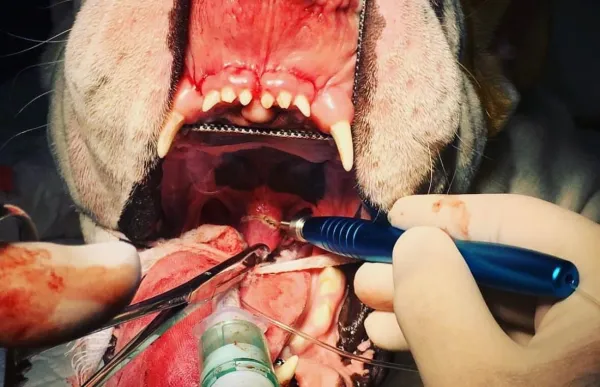
Laser Technology
Multi-Wavelength Laser Technology for Veterinary Dentistry
Laser technology can provide veterinary dental professionals with controlled energy delivery for selected soft tissue, periodontal and dental procedures. Different wavelengths interact with biological tissues in different ways, allowing the laser system to be selected according to the clinical application and treatment objective.
GIGAA provides multiple diode laser wavelengths for veterinary dentistry, including 445/450 nm blue diode laser, 810 nm, 980 nm and 1064 nm.
445 / 450 nm Blue Diode Laser
Blue Diode Laser for Precision Veterinary Dentistry
445/450 nm blue diode laser technology has become increasingly important in dental applications because blue laser energy is strongly absorbed by biological chromophores such as hemoglobin.
This can support precise soft tissue interaction with effective cutting and coagulation, making blue diode lasers particularly interesting for selected veterinary dental and oral soft tissue procedures.
Potential Veterinary Dental Applications
- Gingival procedures
- Gingivectomy
- Gingivoplasty
- Oral soft tissue surgery
- Periodontal procedures
- Frenectomy
- Soft tissue lesion removal
- Hemostasis during dental procedures
Key benefits
810 nm Diode Laser
810 nm for Soft Tissue and Periodontal Applications
810 nm diode lasers provide a well-established wavelength platform for soft tissue and periodontal applications.
The wavelength can provide a balance between tissue penetration, cutting and coagulation, making it suitable for selected veterinary oral soft tissue procedures.
Potential Applications
- Periodontal procedures
- Gingival surgery
- Soft tissue cutting
- Oral lesion removal
- Hemostasis
- Selected photobiomodulation applications
810 nm can be particularly useful for veterinary practices looking for a versatile wavelength that can support both dental and broader soft tissue applications.
980 nm Diode Laser
980 nm for Cutting and Coagulation
980 nm diode laser technology provides strong interaction with water and hemoglobin, making it suitable for selected cutting, coagulation and soft tissue procedures.
In veterinary dentistry, 980 nm can be used for applications where controlled tissue incision and hemostasis are required.
Potential Applications
- Gingival surgery
- Soft tissue incision
- Periodontal procedures
- Oral soft tissue surgery
- Hemostasis
- Selected dental surgical procedures
980 nm is also widely used in veterinary soft tissue surgery, allowing one laser platform to support both dental and general surgical applications.
1064 nm Diode Laser
1064 nm for Deeper Tissue Interaction
1064 nm provides a different tissue interaction profile from shorter diode wavelengths and can offer greater penetration into biological tissue.
For veterinary dentistry, 1064 nm may be considered for selected soft tissue and therapeutic applications where deeper tissue interaction is desired.
Potential Applications
- Selected periodontal applications
- Oral soft tissue procedures
- Photobiomodulation
- Pain and inflammation management
- Selected deeper tissue applications
The clinical use of 1064 nm should be selected according to the target tissue, treatment objective and required tissue effect.
Which Wavelength is Right for Veterinary Dentistry?
| Wavelength | Primary Characteristics | Potential Dental Applications |
|---|---|---|
| 445 / 450 nm | High chromophore absorption, precise cutting & coagulation | Gingival surgery, periodontal procedures, oral soft tissue |
| 810 nm | Balanced penetration and soft tissue interaction | Periodontal & soft tissue procedures |
| 980 nm | Cutting, coagulation & thermal tissue interaction | Gingival surgery, soft tissue procedures, hemostasis |
| 1064 nm | Deeper tissue interaction | Selected periodontal, therapeutic & soft tissue applications |
Recommended Systems
Clinical Resources
Veterinary Dental Laser Guide
Veterinary Dentistry Laser Protocols
Dental Fiber Selection Guide
FAQ
A veterinary dental laser is a laser system designed to deliver controlled optical energy for selected dental, periodontal and oral soft tissue procedures.
Depending on the wavelength and treatment parameters, veterinary dental lasers can support applications such as gingival procedures, periodontal treatment, soft tissue surgery and hemostasis.
There is no single wavelength that is best for every veterinary dental procedure.
445/450 nm blue diode lasers are particularly attractive for precise soft tissue cutting and coagulation, while 810 nm and 980 nm provide versatile platforms for periodontal and oral soft tissue procedures. 1064 nm can be considered for selected applications requiring deeper tissue interaction or therapeutic use.
The appropriate wavelength depends on the target tissue, procedure and desired clinical effect.
445/450 nm blue diode lasers are visible blue wavelengths that are strongly absorbed by certain biological chromophores, including hemoglobin.
This allows efficient interaction with vascularized soft tissue and can support precise cutting and coagulation during selected dental and oral soft tissue procedures.
Blue diode lasers are increasingly used in dental applications and may be considered for selected veterinary dentistry procedures.
Yes. Depending on the wavelength, fiber and treatment parameters, diode lasers can be used for selected periodontal and gingival procedures.
Potential applications include gingival surgery, soft tissue management, hemostasis and selected periodontal treatments.
Clinical protocols should be selected according to the specific procedure and veterinary assessment.
A multi-wavelength platform allows veterinary professionals to select different wavelengths according to the target tissue and clinical objective.
For example:
445/450 nm → precision soft tissue cutting and coagulation
810 nm → versatile soft tissue and periodontal applications
980 nm → cutting and coagulation
1064 nm → selected deeper tissue and therapeutic applications
This flexibility can make a multi-wavelength laser platform suitable for veterinary hospitals with diverse dental, surgical and therapeutic requirements.
Not Sure Which Laser System Fits Your Application?
Choosing the right wavelength and power configuration is essential for achieving optimal clinical performance.
Our veterinary laser specialists can help you select the right solutio