



Laser Technology for Veterinary Endoscopic Procedures
Compact and flexible laser platforms designed for fiber-based and minimally invasive veterinary procedures.
What is Veterinary Endoscopic Laser Surgery?
Laser energy can be delivered through optical fibers to selected target tissues during minimally invasive and endoscopic procedures. Fiber-based laser delivery allows the laser source to be integrated into different procedural workflows.
Laser Technology
Fiber-Delivered Laser Technology for Endoscopic Procedures
Laser energy can be delivered through optical fibers, providing flexible access to confined anatomical areas during selected minimally invasive and endoscopic procedures.
GIGAA laser platforms combine controlled laser energy delivery with multiple wavelength and power configurations, allowing veterinary professionals to select an appropriate system according to the procedure, target tissue and endoscopic workflow.
For endoscopic applications, 1470 nm diode laser technology and 1940 nm Thulium Fiber Laser technology can provide high-precision energy delivery for selected tissue ablation and minimally invasive procedures.
1470 nm Diode Laser
1470 nm – High Water Absorption for Fiber-Based Procedures
1470 nm laser energy has a high absorption in water, allowing efficient interaction with water-rich biological tissues.
This characteristic makes 1470 nm relevant to selected minimally invasive and endoscopic procedures where controlled tissue ablation and precise fiber-based energy delivery are required.
Potential application areas include:
- Endoscopic soft tissue procedures
- Tissue ablation
- Minimally invasive surgery
- Selected urological procedures
- Fiber-delivered procedures
Diode Laser Technology →
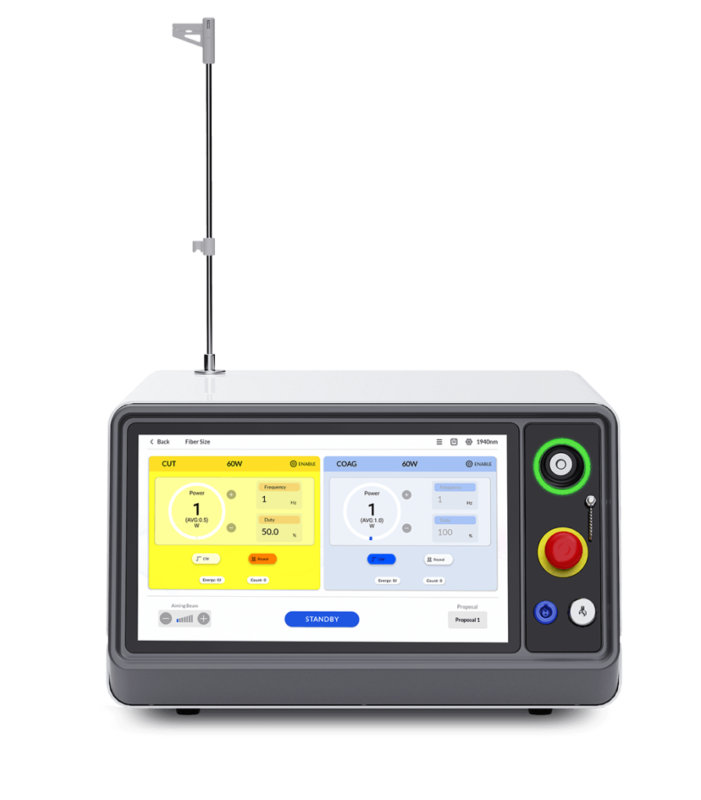
1940 nm Thulium Fiber Laser
1940 nm Thulium Fiber Laser
High-Power Laser Technology for Advanced Endoscopic Applications
1940 nm Thulium Fiber Laser technology provides strong absorption in water and enables efficient energy delivery to water-rich tissue.
GIGAA’s high-power Thulium Fiber Laser platform is designed for advanced surgical applications where precise cutting, vaporization and tissue ablation are required.
Key advantages:
- 1940 nm wavelength
- High-power output
- Precise fiber-based energy delivery
- Suitable for selected endoscopic and minimally invasive procedures
- Designed for demanding surgical applications
Thulium Fiber Laser Technology →
⚡ EMC & Endoscopic Compatibility
Stable imaging matters in minimally invasive procedures.
Poor electromagnetic compatibility between laser equipment and endoscopic imaging systems may cause image interference, including flickering or unstable video signals.
When selecting a laser for endoscopic applications, evaluate:
✓ EMC performance
✓ Endoscope compatibility
✓ Camera system compatibility
✓ Video processor compatibility
✓ Complete system configuration
Recommended Systems
Explore compatible equipment and solutions for Endolifting procedures
Clinical Case Studies
Canine rehabilitation
Joint pain management
Soft tissue injury
Equine recovery
FAQ
A laser system operating near an endoscopic imaging system should be evaluated for electromagnetic compatibility (EMC).
If the laser and endoscopic equipment are not adequately compatible, electromagnetic interference may affect the imaging system and potentially result in image flickering, video interference or unstable signals during laser operation.
This is why EMC should be considered when selecting a laser for endoscopic procedures.
The compatibility of the complete system should be evaluated, including the:
- Laser system
- Endoscopic camera
- Video processor
- Light source
- Monitor
- Cables and connections
GIGAA recommends verifying compatibility with the actual endoscopic imaging system before clinical use.
Image flickering during laser activation can be associated with electromagnetic interference between the laser system and the endoscopic imaging equipment.
Endoscopic camera systems, video processors and monitors are sensitive electronic components. If electromagnetic compatibility is not adequately addressed, electrical or electromagnetic interference may affect the video signal.
The issue may depend on the specific combination of laser, camera, video processor, cables, grounding and operating environment.
For this reason, EMC performance and system-level compatibility should be considered during the selection and integration of a laser for endoscopic applications.
If image interference occurs, the complete equipment configuration should be evaluated by qualified technical personnel.
Laser-assisted endoscopic surgery uses laser energy delivered through an optical fiber or compatible endoscopic delivery system to perform selected tissue procedures through minimally invasive access.
Compared with conventional open surgery, endoscopic laser procedures can provide access to confined anatomical areas while allowing controlled energy delivery at the treatment site.
Depending on the laser wavelength, power and fiber configuration, applications may include tissue ablation, cutting, coagulation and selected minimally invasive procedures.
GIGAA provides diode and Thulium Fiber Laser platforms for veterinary applications requiring fiber-based and endoscopic laser energy delivery.
Different wavelengths can be selected depending on the target tissue, procedure and required tissue effect.
1470 nm diode lasers provide high absorption in water and can be used for selected fiber-based and minimally invasive procedures.
1940 nm Thulium Fiber Lasers provide even stronger interaction with water-rich tissue and are particularly relevant to advanced surgical applications requiring precise cutting, vaporization or tissue ablation.
The appropriate wavelength and treatment parameters should be selected according to the clinical indication, target tissue, fiber configuration and veterinary protocol.
1470 nm has relatively high absorption in water, allowing efficient interaction with water-rich biological tissue.
When delivered through an optical fiber, 1470 nm laser energy can provide controlled and localized tissue interaction, making it suitable for selected minimally invasive and endoscopic applications.
The actual clinical effect depends on factors including power, operating mode, fiber configuration, treatment speed and tissue characteristics.
Yes. 1940 nm Thulium Fiber Laser technology can be used for selected advanced endoscopic and minimally invasive surgical applications when the laser system, fiber and endoscopic equipment are appropriately configured.
The high water absorption of the 1940 nm wavelength allows efficient interaction with water-rich tissue and can support applications requiring cutting, vaporization or tissue ablation.
GIGAA offers high-power Thulium Fiber Laser platforms for demanding veterinary surgical applications.
In addition to wavelength and output power, veterinary professionals should consider:
- Wavelength and tissue interaction
- Output power and operating modes
- Fiber compatibility
- Endoscope compatibility
- Electromagnetic compatibility (EMC)
- Camera and video processor compatibility
- System integration
- Safety and clinical workflow
For advanced endoscopic procedures, the laser should be evaluated as part of the complete surgical system rather than as an independent device.
For veterinary endoscopic applications, the appropriate GIGAA platform depends on the required wavelength, power and procedure.
GBOX
635 + 980 + 1470 nm | Up to 30.5 W
A flexible multi-wavelength platform for selected fiber-based and minimally invasive applications.
VELAS II
635 + 980 + 1470 nm | Up to 57 W
A higher-power platform for advanced veterinary surgical applications.
Thulium Fiber Laser
1940 nm | Up to 400 W
A high-power platform for demanding surgical applications requiring precise tissue cutting, vaporization or ablation.
Compare Veterinary Laser Systems →